Structured, longitudinal patient-generated health data - normalized the moment it's logged, ready for real-world and observational research.
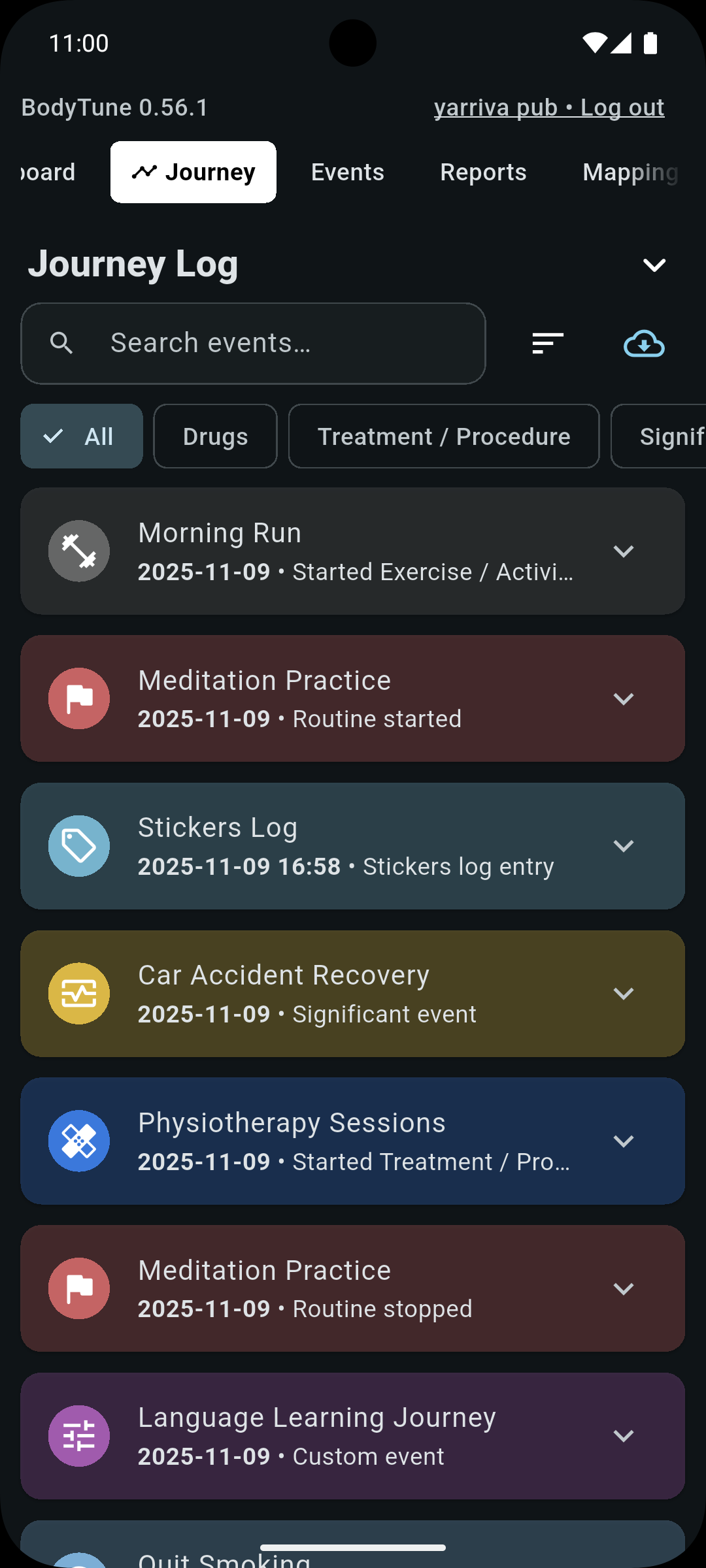
Every entry - medications, symptoms, body-map severity scores - is timestamped and structured on capture.
Drop it straight into R, Python, or SPSS. No wrangling, no cleanup.
No app to build. No server for your team to secure. Participants use their own private
cloud and decide when and how to share their timeline with you - there's no background
collection to disclose to your IRB.
We built this for observational studies, N-of-1 designs, and real-world evidence -
not to replace a GCP-certified eCOA platform for registrational drug trials, and we're
not trying to. Studies with stricter data-integrity needs are welcome to reach out -
options like entry-locking can be discussed on a case-by-case basis.
Approved research teams receive
24 months of Premium access
for all study participants - completely free. No grant line item, no per-participant licensing.
Follow the BodyTune Explained series on 𝕏 - architecture, product decisions, and development notes: #BodyTuneExplained on 𝕏
Towards the launch of this project, I realized that it was one piece of a puzzle from a collection of
projects that have as their common thread the return of power and control over information and privacy
to the customer. Decentralizing the centers of power while improving service and increasing the stability
of systems without centralized control.
BodyTune takes this principle and uses it in the medical physiological field.
The app allows the user to track daily sensations, loads, and actions, discover patterns over time,
and generate real insights - and all of this without a server, without data collection, and without any
connection to health systems or data companies. All information remains on the user's drive, and any insight
belongs only to the user.
Full user-owned privacy -
Stored locally and uploaded only to the user's personal Drive account -
fully owned, with no third-party access.
Neutral, reversible, and ready for export to any other analysis tool.
No central server -
No external database, no collection, no "profile" on the user.
Just a per-session AI request based on the level of exposure you choose.
Intuitive and innovative body mapping -
A simple and stable "sticker" model that allows you to mark only a change
(good/bad) in a chronic condition - not a huge feed that overwhelms the user.
Real pattern finding over time -
Not just a "symptom diary": looks for connections between symptoms/feelings
↔ real-world actions, double-blind - without bias and without the user directing the result.
AI-initiated and targeted reports -
The user defines the ranges, questions, events and notes.
AI generates insights based on raw data only - flexible, accurate,
modular, and compatible with any existing/future AI model.
Spot recording only -
No daily reporting required.
Only when a noticeable change or specific action occurs
(drug, habit, effort, etc.).
Intended for chronic conditions and real life -
Pain, digestion, stress, energy, recovery - the focus is on those who
live with fluctuations and do not want to rely on memory alone.
Open and visible data export -
Raw files can be analyzed in any other tool.
The user is the owner, not the “product”.
Interpretation in a separate layer (double-blind design) -
Step 1: raw data only.
Step 2: interpretation works only on the raw product → reduces costs,
increases accuracy, and maintains scientific neutrality.
Distributed and long-lasting infrastructure -
No company can crash and take data with it.
As long as there is internet or a private drive, the system remains live
and stable.
How to Use
BodyTune is designed to be simple and intuitive, without requiring changes to your daily routine.
The goal is not to “keep a diary,” but to identify real patterns in your life - which is why BodyTune uses a point-based approach:
you only report when something changes or when something feels important to remember.
The steps below explain how to get accurate and consistent insights over time.
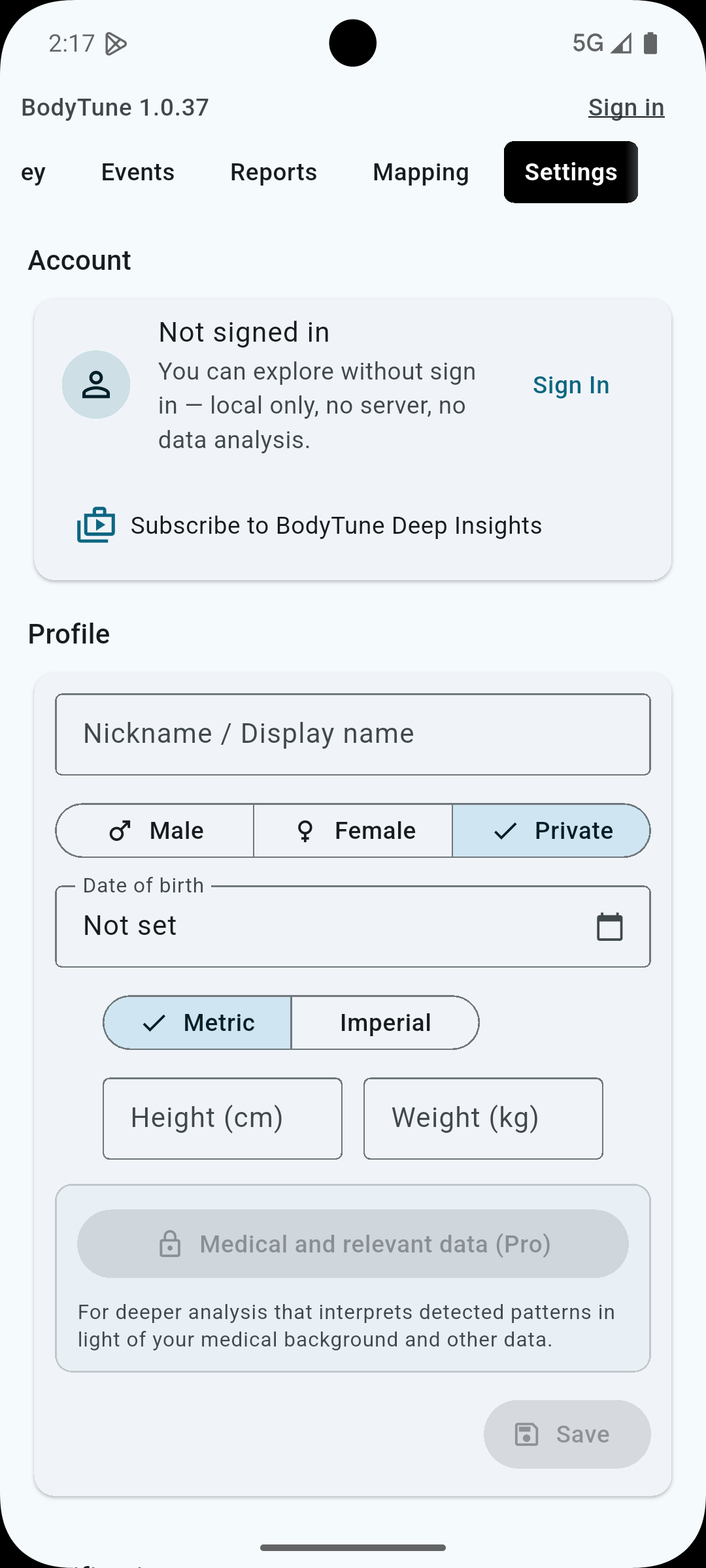
Step 1 - Set Up Your Profile & Sign In
BodyTune does not use a central server and does not collect any user data.
Instead, everything is saved directly into your own Google Drive, in a regular, open folder
that belongs entirely to you. Nothing is encrypted or hidden - these are plain files under
your full ownership and responsibility. This ensures that your data stays portable,
transparent, and accessible to any tool you choose in the future.
BodyTune’s insights become more accurate when the system understands your baseline -
your body type, background, and physiological context.
This setup is done once, quickly, and helps all future reports become more meaningful.
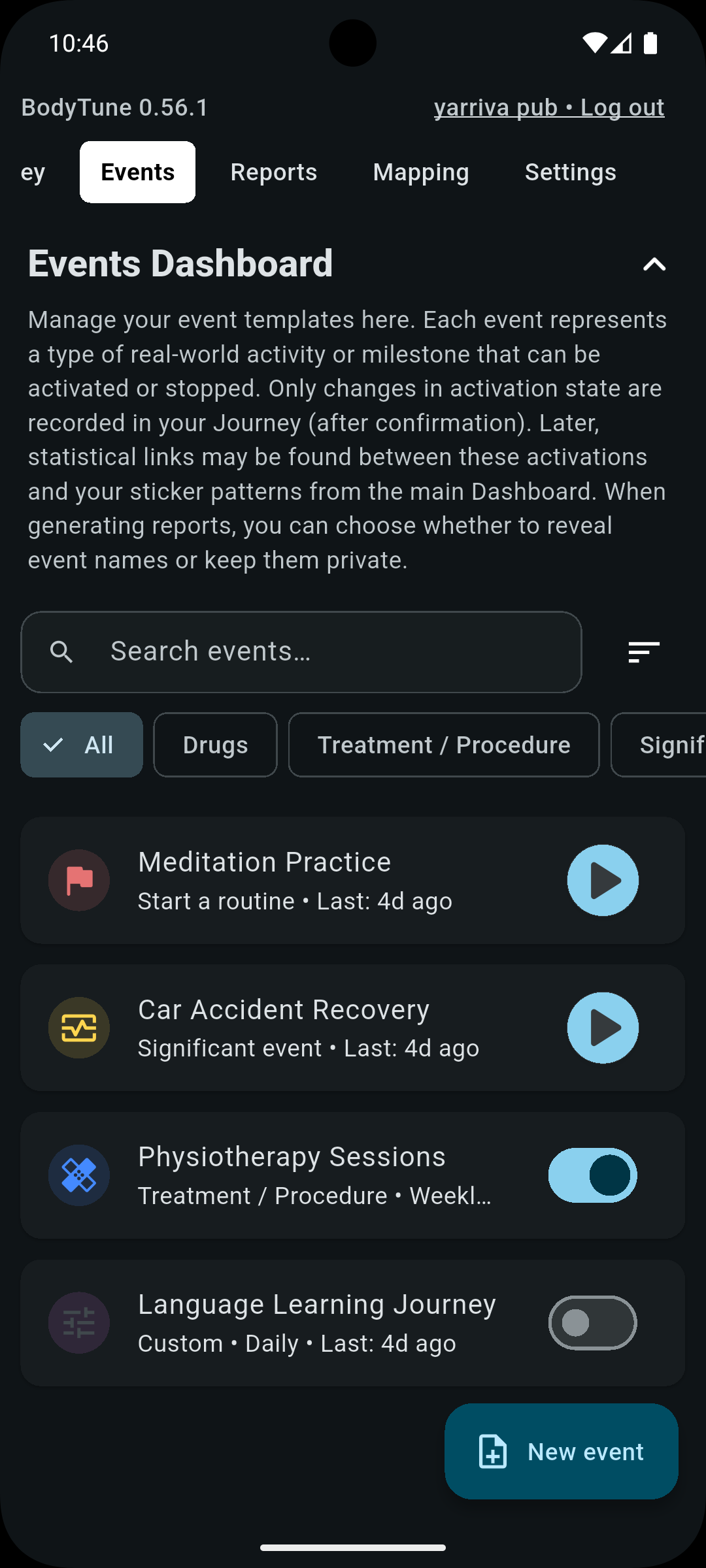
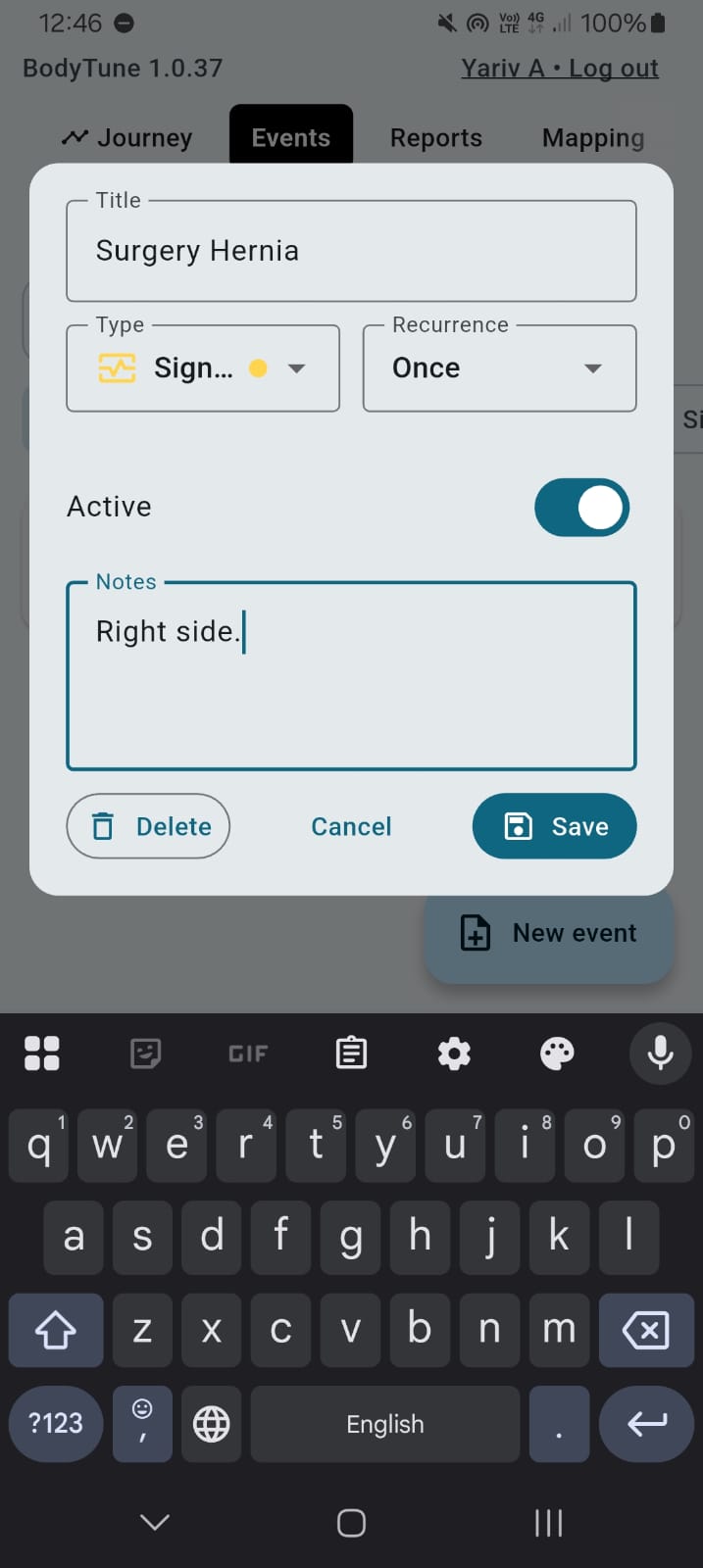
Step 2 - Set Up Your Event Templates
In this screen you create abstract event templates - not actual journal entries.
These are the repeating actions, habits, medications, or meaningful moments you may want
to log later with a single tap.
Create each type of action/medication/activity once - then log it instantly later with a
single tap. Entries are created only when tapped, not when templates are created.
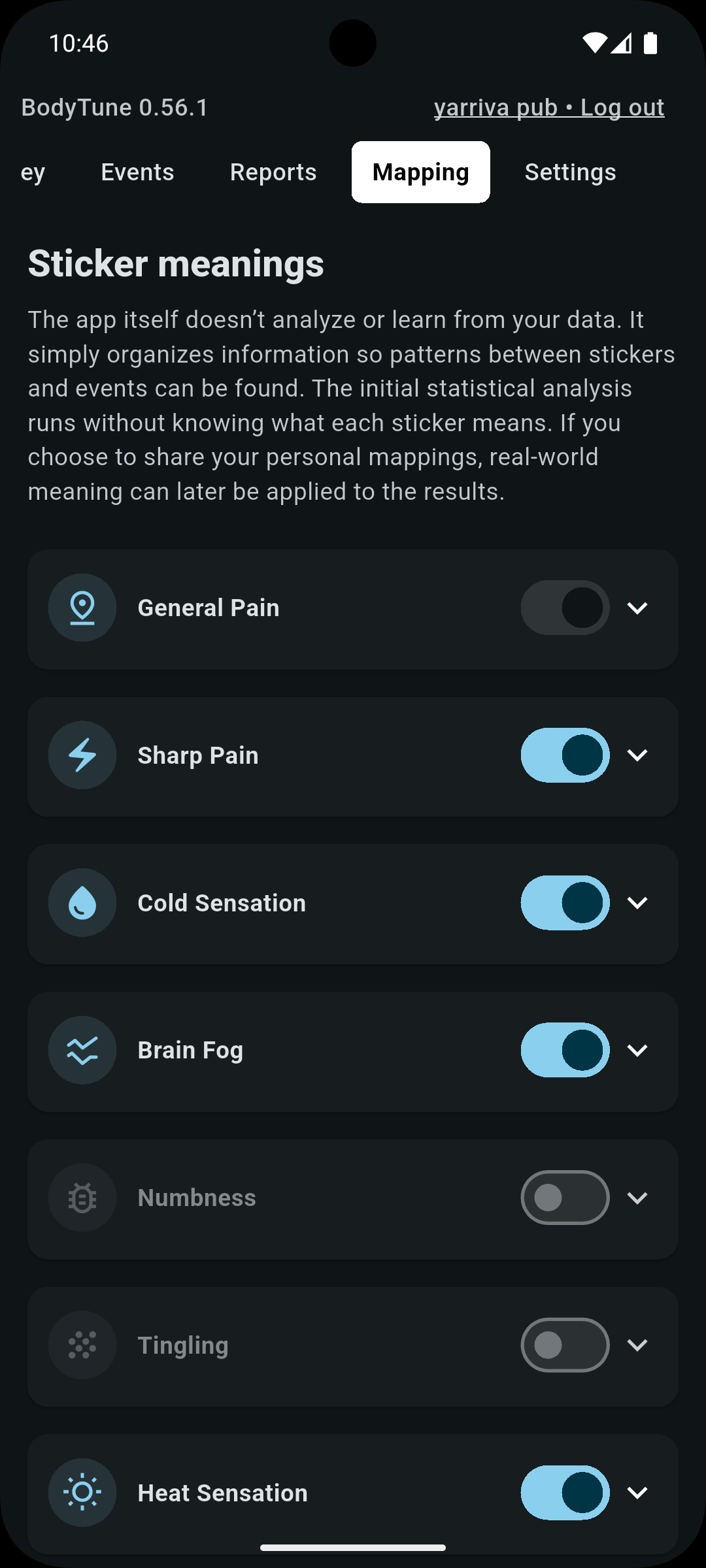
Step 3 - Stickers
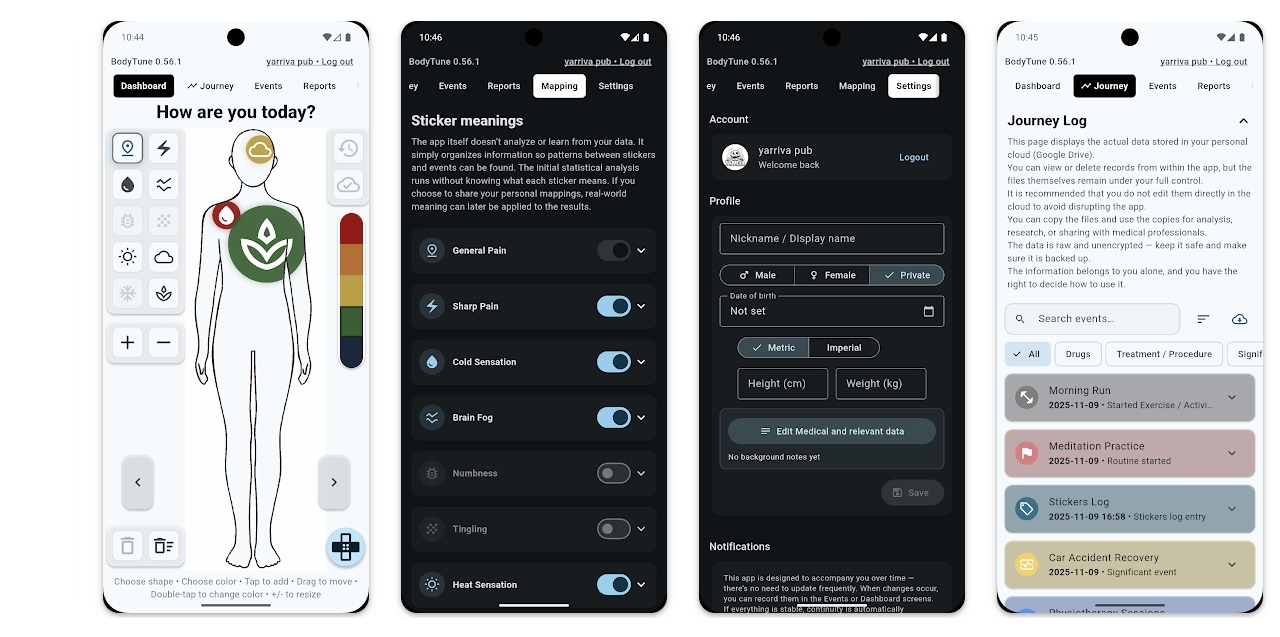
Stickers represent the sensations or signals you want to track on your body map.
Just enable the ones that matter to you (editable) - sharp pain, cold sensation, brain fog,
tingling, heat, and so on. You don’t need to teach the system anything; the meanings are
optional and only help later during interpretation.
Each time you mark a location on your body, you choose a sticker.
This consistent tagging allows BodyTune to detect patterns between the type of sensation,
where it appears, and the actions or events you logged throughout the day.
BodyTune’s statistical analysis runs first without knowing the real-world meaning of each sticker.
If you choose to share your personal meanings later during an AI report, that interpretation
layer can enrich the insights - but the tracking itself stays simple, neutral, and fast.
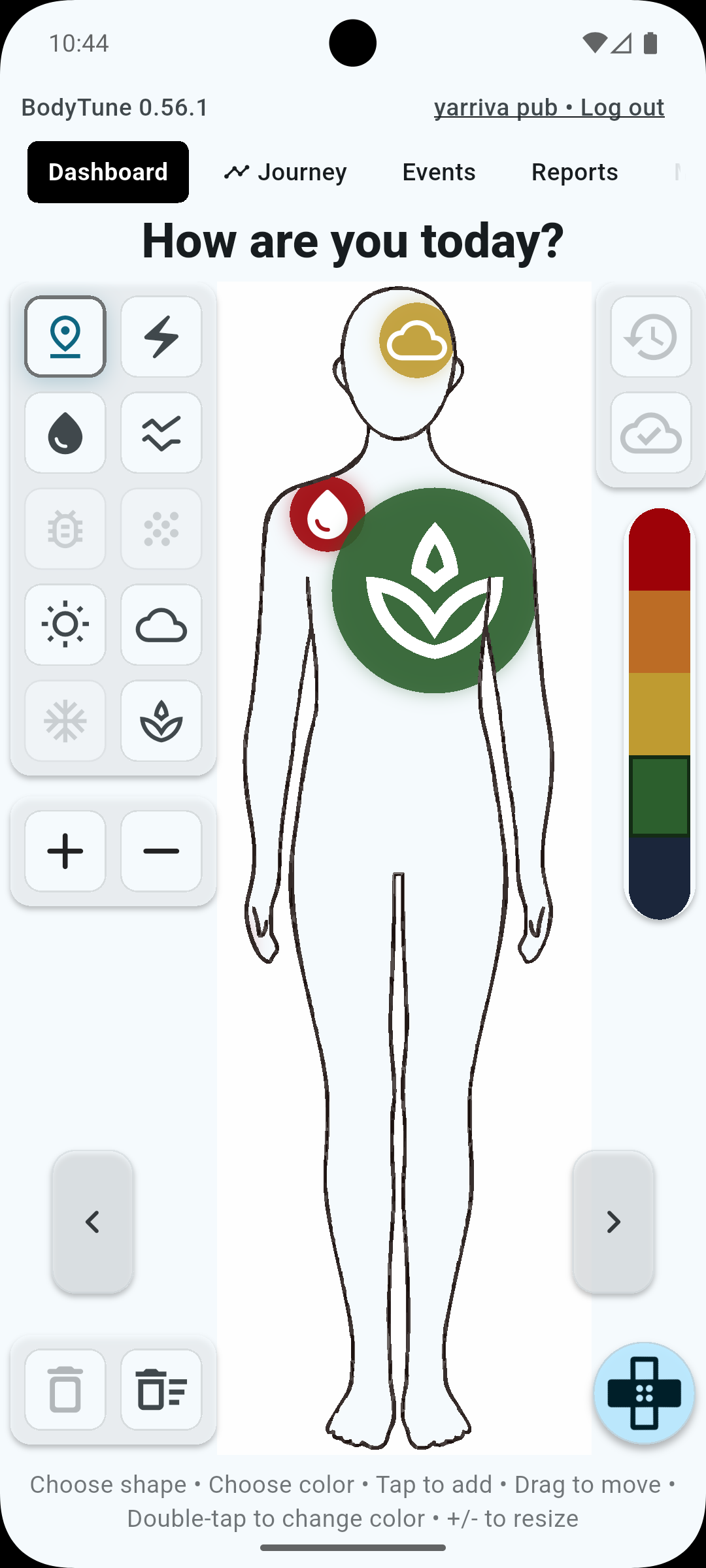
Step 4 - Dashboard
The body map is where you record how you feel at the moment you’re logging, not as a daily task.
You only add or adjust stickers when something actually changes - pain, relief, tension, fatigue,
digestion shifts, and so on.
This keeps your log clean and meaningful:
no updates = no change, and the system preserves the last known state automatically.
There’s no need to build new habits or report every day - BodyTune is designed to fit real life,
not to burden it.
Over time, these moment-based updates allow BodyTune to detect real, long-term patterns
without overwhelming you.
Step 5 - Journey
The Journey is the single source of truth for your data in the cloud.
Every entry is a fixed timestamp snapshot of your state at the moment of logging -
either by tapping an event in the Events page or by saving the current sticker map.
Entries cannot be edited, only deleted, so the timeline stays consistent and trustworthy.
BodyTune follows a deliberate strategy of saving data only when something actually changes.
The app does not log indirectly or continuously - the assumption is that “no new entry” means
“no meaningful change.” This prevents data overload and keeps the statistical analysis focused
on real signals instead of noise.
The same strategy also keeps your Journey readable and useful at the human level:
instead of endless repetitive logs, you get a clear, meaningful history of the moments
that really mattered - both for you and for future analysis.
Step 6 - Analyze
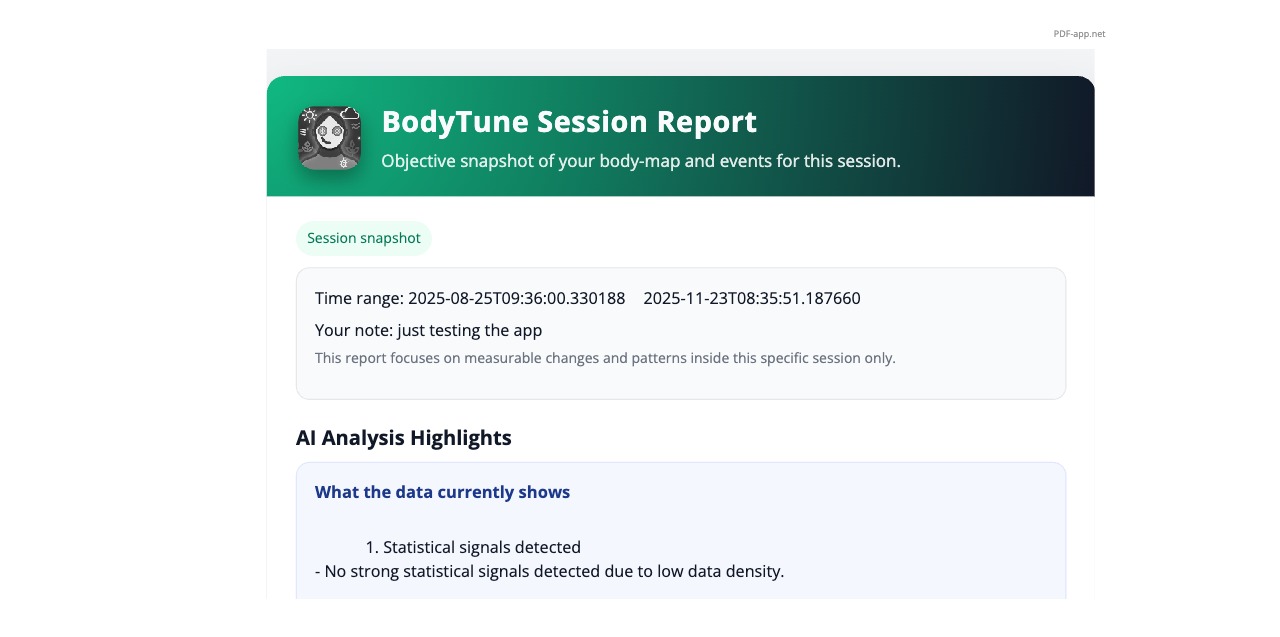
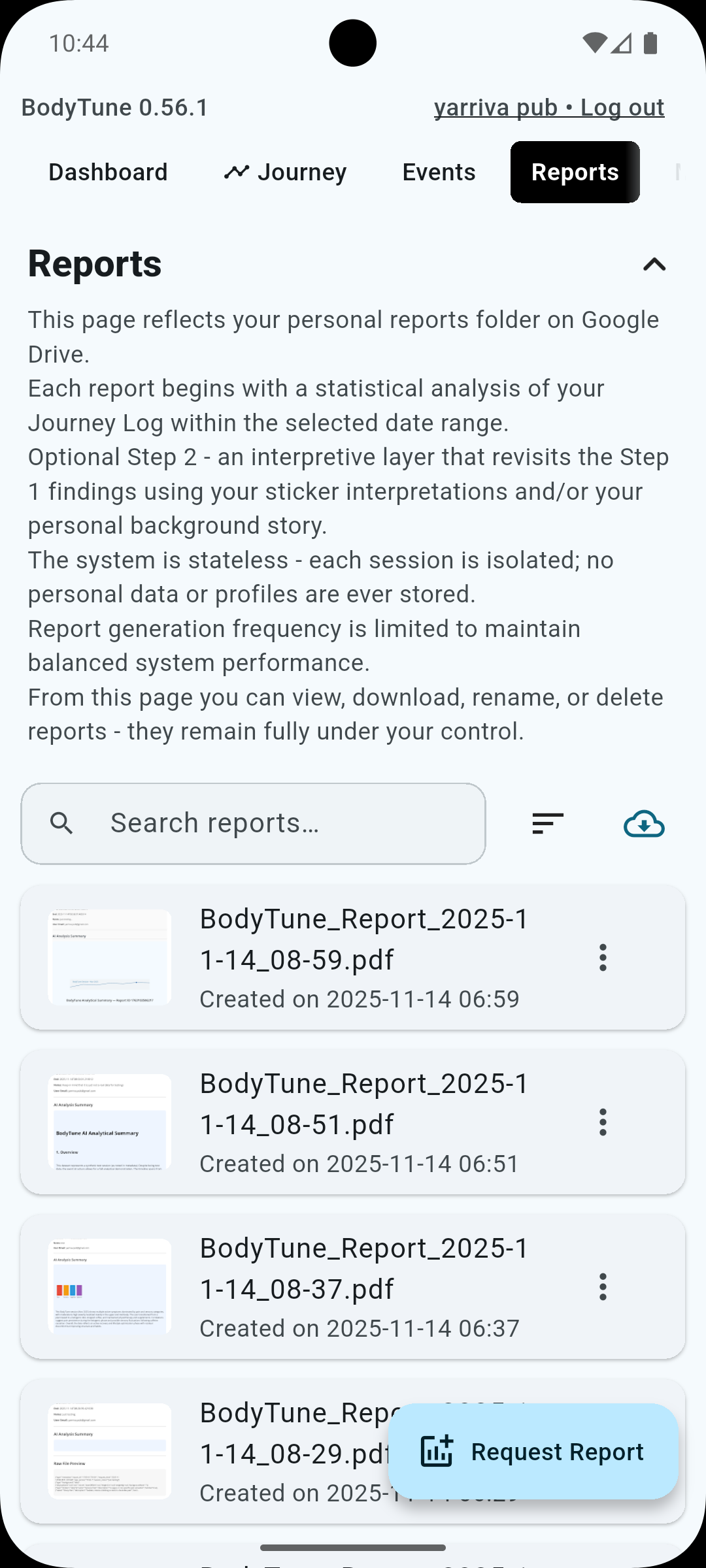
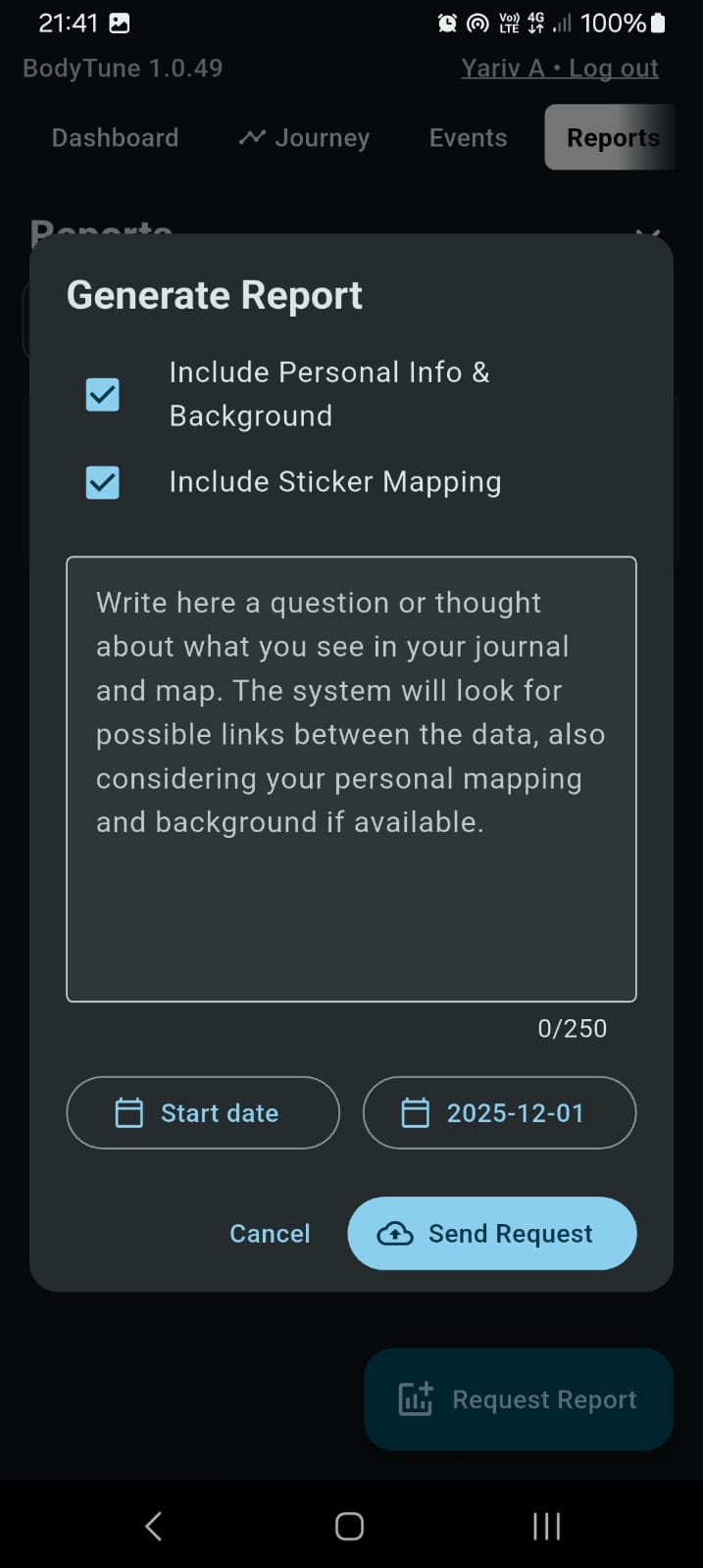
When a user requests an insight report, the app sends only the relevant journal files (JSONL) from the selected date range. No additional data is transmitted, no silent collection occurs, and the server does not retain any history between sessions.
The processing on the server is intentionally divided into two separate stages to reduce bias and maintain analytical neutrality:
1. Blind statistical stage - the server analyzes the raw log entries purely as time-based events, without any personal context, user background, or sticker interpretations. At this point, the system detects patterns, timing structures, frequencies, and trends, relying exclusively on what is encoded in the journal files. No keywords, no user-specific assumptions, and no emotional or semantic layers are introduced.
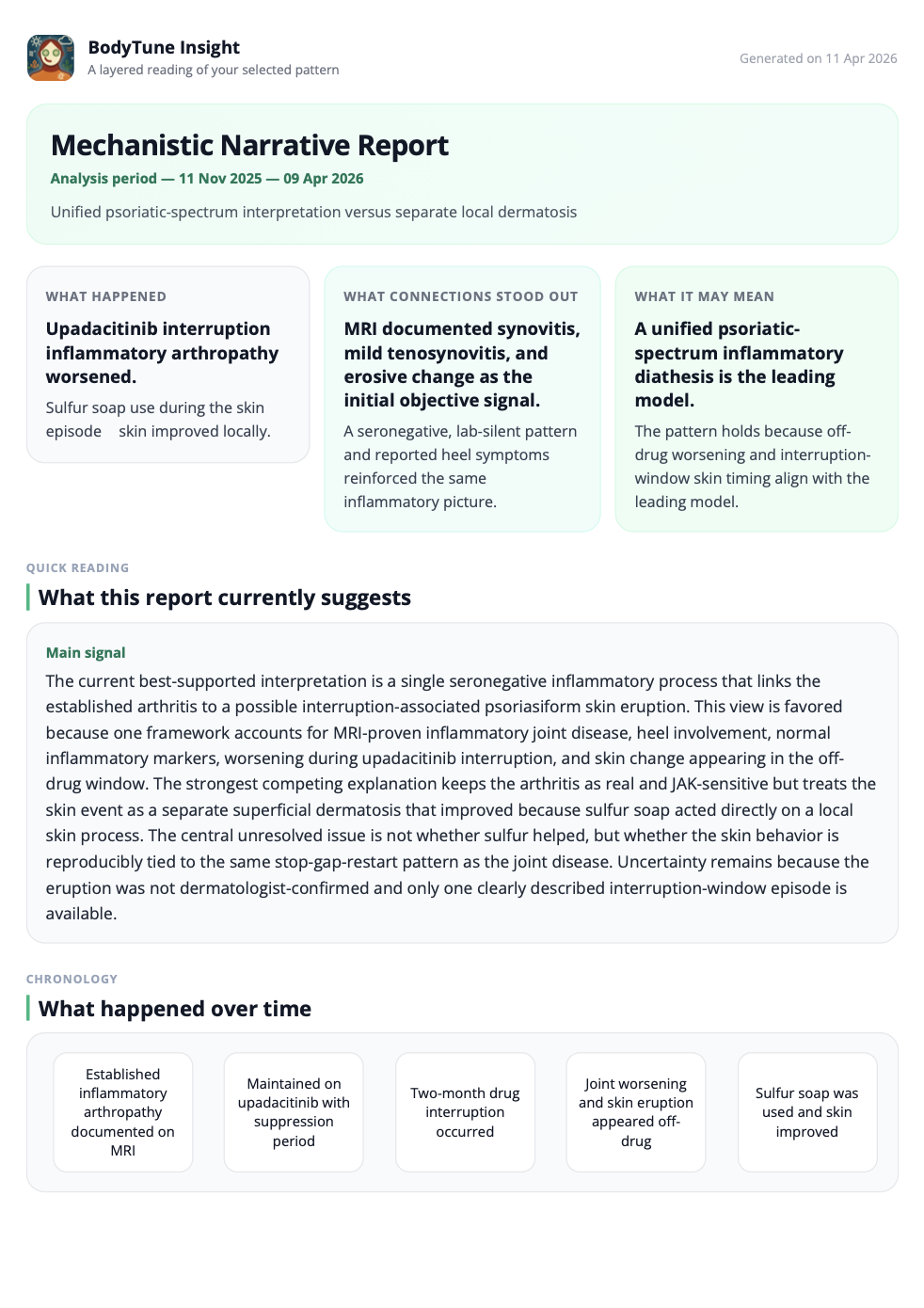
2. Contextual stage - once the blind statistical layer is complete, the system enriches the analysis with optional context provided in the app’s settings: personal background, basic profile information, and the user’s own sticker-meaning map. The notes included in the report request help direct the focus of this specific session, but they do not modify or override the underlying data.
Each report request creates its own isolated session. The server does not accumulate information over time, does not build user profiles, and does not store intermediate data. Once the analysis is finished, the server returns a single JSON result containing only the insights for that request. No copies of the user’s journal are preserved on the server.
The final report is written automatically into the app’s dedicated Google Drive folder - the only source of truth in the entire system. Users may rename or delete old reports, but the content of each report remains fixed, ensuring a clean, chronological, and tamper-free history.
While the underlying analytical methods will continue to improve over time - better pattern detection, lower noise, and more adaptive models - the core principles stay constant: minimal bias, full user data ownership, and an accurate reflection of exactly what exists in the user’s Drive, no more and no less.
Roadmap
The roadmap outlines the development priorities, the philosophy behind the system, and the future capabilities planned for the platform.
Phase 1: Stabilization & Accuracy (Dec 2025)
The top priority is to stabilize the app and ensure that all core workflows operate reliably, quickly, and without errors.
This phase includes bug fixes, refinement of client-side behavior, and user-experience improvements - without adding new features.
In parallel, server-side report processing continues to improve:
the two-stage analysis (“digital double-blind”) reduces bias and increases accuracy.
Bug fixes and UI/UX refinement.
Improved reliability of all core flows.
Two-stage blind statistical report processing.
Deeper focus on report quality once the app stabilizes.
Scope: Stabilization of the entire app and refinement of server-side processing.
Phase 2: Near-Term Expansion
After full stabilization, new features will be introduced based on insights from Phase 1.
This phase will also include major platform extensions.
Feature additions guided by data from the initial rollout.
Future Directions
Once BodyTune is mature and stable, several advanced capabilities are planned or under evaluation.
Integration with phone-based health data (Heart Rate, Stress, Sleep), subject to privacy and permissions.
Optional AI analysis of uploaded medical documents.
Animated visualization of sticker movement across time and events.
Support for additional cloud services (e.g., Apple's ecosystem) and alternate AI engines.
Potential transition to open-source if sufficient financial support exists.
These directions will be prioritized based on user needs, impact, and available resources.
Commitment & Data Principles
BodyTune follows strict, non-negotiable principles regarding user data and system integrity.
These principles define the long-term continuity of the project.
All data is stored exclusively on the user's tools (currently Google Drive).
The user is never the product.
The app only organizes and normalizes data; processing is optional and always manual.
No server permanently stores user data (beyond third-party service guarantees).
These principles will always remain. If any principle must be broken, a new app under a different name will be created - BodyTune itself will not violate them.
FAQ
Feel free to email me your questions - I’ll compile the answers and update them here.